
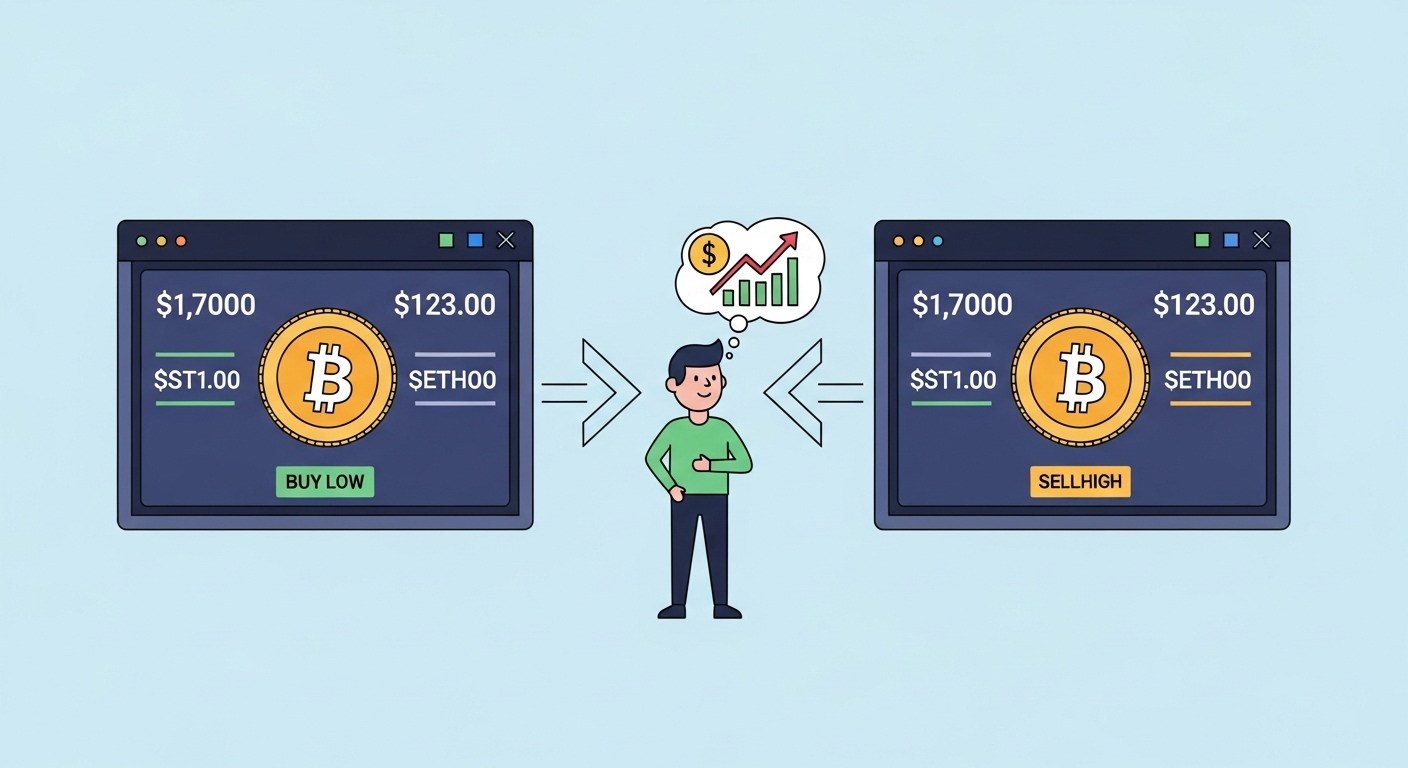
Earning crypto by spotting price differences across exchanges isn’t just for professional traders anymore, anyone can learn how to do crypto arbitrage.
If you’re a freelancer, small business owner, or digital nomad, understanding how to do crypto arbitrage can turn market volatility into steady opportunities.
What Is Crypto Arbitrage?
Crypto arbitrage is a simple concept with powerful potential, especially if you’re looking for practical ways to grow your crypto holdings, and learning how to do crypto arbitrage makes it even more accessible.
It means taking advantage of price differences for the same cryptocurrency on different exchanges.
How Crypto Arbitrage Works
Crypto Arbitrage
Picture this: Bitcoin is selling for $40,000 on one exchange, but another site lists it at $40,250.
If you buy on the cheaper exchange and sell on the more expensive one, the difference is your profit (minus fees).
The catch is that these windows don’t stay open for long, so you need to move fast.
You’ll see crypto arbitrage in action when:
- Different exchanges have slight price discrepancies due to supply, demand, and trading volume.
- Market orders flood in, causing temporary gaps before they even out.
Why Do Price Differences Exist?
You might wonder why prices aren’t always perfectly matched.
Crypto markets operate 24/7, with hundreds of exchanges around the world. That constant activity creates:
- Imperfect communication: Not all exchanges update prices at the same time.
- Varying liquidity: Some platforms have more buyers and sellers, affecting price stability.
Common Types of Crypto Arbitrage
If you’re serious about learning how to do crypto arbitrage, it’s helpful to know there are several main approaches:
- Spatial Arbitrage: Buying and selling the same asset on different exchanges, as described above.
- Triangular Arbitrage: Taking advantage of three different currency pairs within one exchange for a profit loop.
- Statistical Arbitrage: Using bots and automated tools to scan for price gaps with algorithms.
How Fast Do You Need to Act?
Speed matters. Price gaps can close in seconds as traders rush to buy low and sell high.
Many who practice crypto arbitrage use trading bots, automation tools, or real-time apps to boost their odds.
Types of Crypto Arbitrage Strategies
If you want to learn how to do crypto arbitrage, it pays to know the different ways traders find profit.
These strategies can work whether you’re a solo freelancer, a small business owner looking to grow extra income, or someone who simply wants to take advantage of crypto price swings.
Cross-Exchange Arbitrage
Cross-exchange arbitrage is the classic method of buying on one platform, selling on another.
The idea is simple: some exchanges lag behind others in updating prices or have more buyers and sellers at a given time.
This creates small windows for profit.
Here’s a step-by-step breakdown:
- Scan for price gaps: Use an app or website to compare the price of, let’s say, Ethereum on two exchanges.
- Act fast: Once you notice Ethereum selling for $1,850 on Exchange A and $1,870 on Exchange B, you have to move quickly.
- Buy low: Purchase ETH on Exchange A for $1,850.
- Transfer funds: Send your ETH from Exchange A to Exchange B. Speed is crucial in crypto markets move in seconds.
- Sell high: Sell ETH on Exchange B at $1,870.
Triangular Arbitrage
Triangular arbitrage might sound complex, but it’s a doable method even for non-pros.
Here, you take advantage of price mismatches between three cryptocurrencies on the same exchange.
Imagine this scenario:
- On Exchange X, you notice these rates:
- BTC/ETH: 1 BTC = 14 ETH
- ETH/USDT: 1 ETH = $2,000
- BTC/USDT: 1 BTC = $27,500
You start with $27,500 in USDT:
- Buy ETH using USDT: $27,500 / $2,000 = 13.75 ETH.
- Swap ETH for BTC: 13.75 ETH / 14 = 0.982 BTC.
- Trade BTC for USDT: 0.982 BTC x $27,500 = $26,995 (wait—this is a loss!)
But, say the BTC/ETH rate lags and lets you get 15 ETH for 1 BTC instead:
- You’d end up with more than you started, netting a small gain risk-free.
Decentralized Arbitrage and Flash Loans
More users are learning how to do crypto arbitrage while migrating from central exchanges (CEX) to decentralized exchanges (DEX) for extra flexibility and privacy.
The difference is clear: CEXs work more like regular banks with account signups and KYC, while DEXs are open to anyone and offer direct wallet-to-wallet trades.
How to Do Crypto Arbitrage: Step-by-Step Guide
Getting started with crypto arbitrage might seem overwhelming, but once you know how to do crypto arbitrage, it’s a clear process.
This part of the guide breaks down the main steps so you can act with speed and confidence, minimize risk, and actually keep your profits.
Choosing Secure Exchanges and Platforms
Your first decision is where to trade.
Picking safe, reliable exchanges is crucial to avoid getting stuck, scammed, or paying hidden fees.
Here’s what to look for:
- Liquidity: Choose platforms with high trading volume. If there aren’t enough buyers and sellers, it can be tough (or impossible) to execute trades at your target price.
- Security: Only use exchanges with strong reputations, two-factor authentication, and a solid history of protecting users’ funds.
- Low Fees: Fees eat into your profit. Compare transaction fees, withdrawal costs, and deposit charges across exchanges to find competitive options.
- Speed of Transfers: Make sure the platform processes deposits and withdrawals quickly.
Monitoring Opportunities and Executing Trades
To succeed with crypto arbitrage, constant monitoring is non-negotiable.
Tracking price gaps across exchanges by hand is tough; let technology give you an edge.
Calculating Profit and Managing Fees
Seeing a price gap is exciting, but don’t celebrate yet, fees and hidden costs can turn a profit into a loss if you’re not careful.
- Trading Fees: Each buy or sell comes with a fee. These might be a flat rate or a percentage of your trade.
- Withdrawal Charges: If you need to move crypto between platforms, check for per-transaction fees (can be steep, especially for coins like Ethereum during busy times).
- Network Costs: The blockchain itself may charge miners’ fees just for moving your funds.
Here’s a basic table to help you track expenses for each trade:
| Expense Type | Example Cost | Where It Applies |
|---|---|---|
| Trading Fee | 0.2% per transaction | Each buy/sell on the exchange |
| Withdrawal Fee | 0.0005 BTC (fixed) | When moving assets offsite |
| Network Fee | Dynamic, varies | Blockchain transfers |
Risks and Challenges in Crypto Arbitrage
Everyone wants to make easy gains, but knowing how to do crypto arbitrage shows that it’s never risk-free.
Even experienced traders see their profits vanish if they ignore the challenges.
Understanding the risks involved can make the difference between a smart move and an expensive lesson.
Speed and Execution Risk
Crypto prices can shift in the blink of an eye.
By the time you spot an arbitrage gap and try to execute a trade, the price difference may have disappeared.
Trading Fees and Hidden Costs
Every exchange takes a cut, meaning even tiny trading fees and withdrawal costs can eat into your profit.
An arbitrage spread that looks great at first might barely break even or become a loss after fees are subtracted.
Here’s a quick look at how fees impact your margin:
- Trading fees: Charged per transaction (buy/sell).
- Withdrawal fees: Transferring coins between exchanges can add flat or variable costs.
- Network fees: Some blockchain transactions carry unpredictable costs.
Liquidity and Slippage
If you try to buy or sell a large amount of crypto, you may find there aren’t enough buyers or sellers at your desired price.
This lack of liquidity can cause “slippage”, where you end up trading at a worse rate than expected.
Transfer Delays and Blockchain Bottlenecks
In how to do Crypto Arbitrage not every transfer happens instantly.
Blockchains sometimes get congested, and exchanges may review or hold your withdrawal for extra security.
If your crypto gets stuck during a transfer, the opportunity can vanish before your funds arrive.
Security and Exchange Reliability

In learning how to do Crypto Arbitrage, Security is always a concern.
There’s a risk that your funds could be lost, stolen, or compromised due to hacking or technical issues.
Some exchanges have a history of freezing funds, getting hacked, or going offline during volatile markets.
Regulatory and Legal Risks
Different countries have their own crypto laws.
Some exchanges block users from certain regions or freeze accounts for compliance reasons.
Regulations can change quickly, making it hard to predict all the legal implications.
Summary Table: Main Risks in Crypto Arbitrage
| Risk Type | Example Impact | Quick Tip |
|---|---|---|
| Speed/Execution | Missed trades, losses | Use reliable, fast exchanges |
| Fees & Costs | Profits wiped out | Always calculate net profit |
| Liquidity & Slippage | Worse trade rates | Stick to high-volume coins |
| Transfer Delays | Opportunity lost | Check withdrawal times |
| Security Issues | Lost or stuck funds | Prioritize trusted platforms |
| Regulatory Challenges | Account holds/freeze | Know your local rules |
Is Crypto Arbitrage Right for You?
How to do Crypto arbitrage isn’t just a strategy; it’s a style of earning that fits certain personalities and financial situations better than others.
Before diving in, it’s smart to think about your own goals, risk tolerance, and the time and tools you’re willing to commit.
Assessing Your Risk Tolerance
Every investment has risks, but crypto arbitrage comes with unique factors.
Price windows open and close quickly, so hesitation costs money.
If the idea of fast decisions and possible quick losses worries you, this might not be your lane.
Consider these points when thinking about your risk level:
- You might need to act quickly, so confidence is key.
- Possible profits are often small and require precision.
- Fees, market swings, or slow transfers can turn a win into a loss.
Evaluating Your Available Resources
You don’t need a huge bankroll to start, but some resources do make a big difference.
Here’s what sets you up for smoother trades:
- Capital: While micro-arbitrage is possible, more funds give more room to profit after fees.
- Time: Successful arbitrage requires regular price monitoring or reliable trading bots.
Matching Arbitrage With Your Lifestyle
Crypto arbitrage attracts digital nomads, remote workers, and tech-focused small business owners for a reason.
If you value flexibility and like the idea of earning whenever and wherever, this method suits a fast-moving lifestyle.
Personal Motivation and Goals
Ask yourself why you want to learn how to do crypto arbitrage.
Do you want extra income, a new hobby, or a serious side hustle? Is your main goal to supplement freelance income or build a business around trading?
Community and Support
Going solo can be tough.
Crypto arbitrage communities on platforms like Reddit’s crypto arbitrage discussion provide advice, bot recommendations, and help troubleshoot issues.
Learning from others can fast-track your progress and expand your toolkit.
Conclusion
Learning how to do crypto arbitrage comes down to spotting price gaps, acting fast, and carefully tracking your costs.
Start small, use trusted tools, and only risk money you’re comfortable with as you build your skills.
This method suits anyone comfortable making quick decisions and managing some risk in exchange for more flexibility.
If you want to unlock even more ways to earn from crypto, check out extra guides and updates over at the PayApeer Blog Insights.